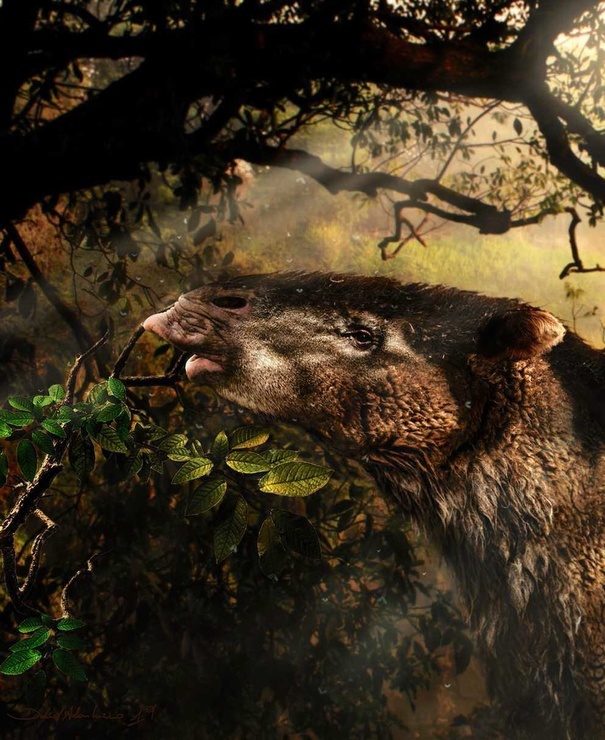
Catonyx tarijensis: Reconstruction of the cranial anatomy and palaeoneurology of a extinct Scelidotheriine Sloth from the Pleistocene of Bolivia.
[sciencythoughts.blogspot.com]
Sloths, Folivora, are today represented by only two genera, Bradypus and Choloepus, and constitute an endemic South and Central American Mammalian clade restricted to Neotropical rain forests. By contrast, their fossil record is extremely rich and diverse, spanning chronologically from the late Eocene to the early Holocene, and geographically covering nearly all of the American supercontinent. The Mylodontidae is one of the most important Folivoran clades, representing a major subdivision of Sloths diversity. Its representatives were mainly quadrupedal and terrestrial, and in some cases developed digging capabilities. Mylodontid Sloths were particularly widespread and abundant in South America, but they also reached Central and North America in different migratory events.


 5
5


Enjoy being online again!
Welcome to the community of good people who base their values on evidence and appreciate civil discourse - the social network you will enjoy.Create your free account
3 comments
Feel free to reply to any comment by clicking the "Reply" button.Interesting! So, with that cranial structure, are they early relative to horses?
 tinkercreek
Level 8
Nov 15, 2020
tinkercreek
Level 8
Nov 15, 2020
0
I had the offer in 1978 to assist Dr. Paul Martin in looking at a giant sloth (Megalatherium) pleistocene site in the Grand Canyon. It was to occur over a Christmas break. Like a fool I passed as I felt compelled to go home for Christmas. I've kicked myself ever since.
 t1nick
Level 8
Nov 15, 2020
1
t1nick
Level 8
Nov 15, 2020
1
The Mylodons were interesting, in that they grew to 8-9 feet in length, and could walk upright for short distances, using their tail as a sort of third leg to balance on. I've read that Charles Darwin supposedly found a badly decomposed Mylodon, along the coast of Patagonia. If true, then at least some of them managed to survive past their presumed extinction.
 davknight
Level 8
Nov 15, 2020
2
davknight
Level 8
Nov 15, 2020
2