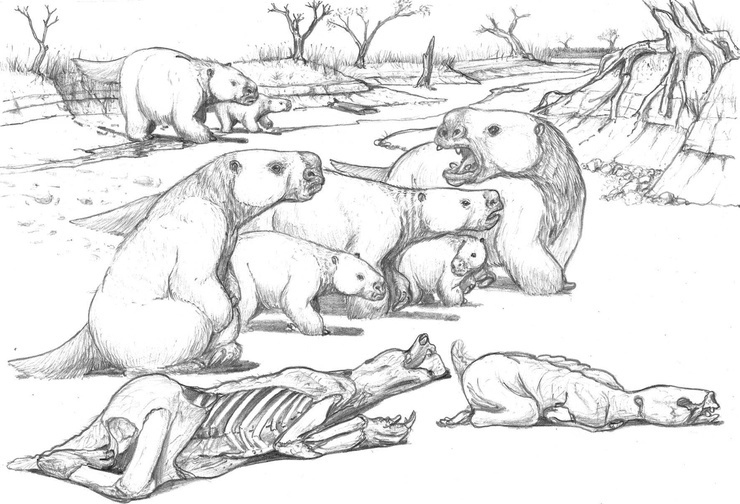
Lestodon armatus: Understanding the ecology and behaviour of a Late Pleistocene Ground Sloth from the Argentine Pampas.
[sciencythoughts.blogspot.com]
In recent years there have been multiple studies on the Quaternary South American Megamammals (Mammals with an estimated body mass at least 1000 kg), including Ground Sloths. Even so, there are several aspects of their life history that have not been addressed in detail, such as growth patterns, diseases, social behavior, habitat preference, feeding strategies, and trophic relationships with other mammals, both endemic to South America and immigrants from North America. Sloths (Xenarthra, Folivora), are one of the most conspicuous groups of Mammals, include representatives of, at least, five monophyletic families, Bradypodidae, Megalonychidae, Megatheriidae, Mylodontidae, and Nothrotheriidae. Representatives of this clade were very abundant and diverse in the Quaternary terrestrial ecosystems in South America. The extinction of Ground Sloths occurred in the late Pleistocene-early Holocene, along with that of the remaining Megamammals; it has been proposed that the main causes of the extinction could be related to climate and environmental changes, diseases, Human action, and combinations thereof. They have no ecological analogues living today, as extant sloths are only represented by obligatory arboreal species of Bradypus (Three-toed Sloths) and Choloepus (Two-toed Sloths), which are restricted to the Neotropical rain forests.
 5
5


Enjoy being online again!
Welcome to the community of good people who base their values on evidence and appreciate civil discourse - the social network you will enjoy.Create your free account